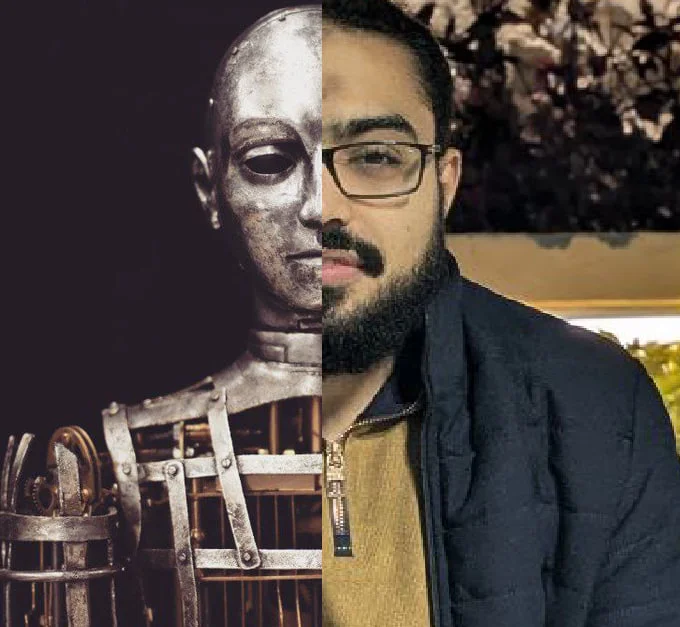
Biography
Umar al-Fayiz
Khanate of pure intellect
It began in Misr, that is Aigyptos — well, in its soil, at least, and in the current era as it naturally passes. You have no doubt already noticed my inability to go long without irony or an aversion to formality. How I loathe suits, neckties, and deceptive diplomacy—and how much I respect the man who says plainly: I am your adversary.
I arrived in the early years of the fifteenth Hijri century and the closing years of the twentieth Roman one — born into a family half Arab and half Turk: a father of Najdi origin, raised in Egypt; a mother of Qurashi Hashemite, and Turkic lineage, likewise raised in Egypt. A child of the age of the suspended Caliphate. One of the people of Egypt.
The first stage in the making of this character began when my family entrusted me to Al-Azhar Ash-Sharif — delivered to it as Baybars was delivered to As-Salih Najmud-Din Ayyub as a child. This is a reference to bondage, not to sultanate. I was taught the Quran and instructed in jurisprudence and the Islamic sciences while I was still learning language itself. Al-Azhar does not joke, and it does not acknowledge childhood. It sometimes seems to expect of you a critical edition of a text written a thousand years ago, in a classical tongue used across that same thousand years, to be completed by your twelfth year and to conform to scholarly consensus — or else you are a disgrace to an edifice that has stood for centuries. I jest, of course. That is only how it appears from the outside.
When I later studied Urdu at university, my Pakistani professor — Dr. Ghulam Qamar, who always called me Faruq on the basis that my name is Umar — would tell me that an Azhari student at high school was regarded by the people of Pakistan as a scholar. I spent most of my university years believing that Professor Qamar was flattering me excessively, only to discover upon leaving that Al-Azhar deliberately refrains from drawing our attention to the strength of our foundation — so as to preserve our humility. Could this be the reason for the treatment of peasants we were receiving as well?
I recall that at fourteen, a friend of my cousin asked me — speaking in the idiom of youth culture, about how one becomes impressive — whether I knew how a man becomes a prince. I answered as an LLM might: a precise jurisprudential account of the conditions of the oath of allegiance, distinguishing the emirate from the supreme imamate and the delegated governorship. The boy stared at me in shock, then turned to my cousin and said: He's joking, isn't he? I was not joking. I had not even understood his original question. I had stepped directly from a simulation spanning the Prophet's (PBUH) mission to the fall of the Ottoman state into the reality of the age of the suspended Caliphate. I realised rather late that there had been no caliph for a hundred years.
If you are not Muslim, the closest analogy is growing up within the Vatican — except that in my story the Vatican is not a sovereign state. Al-Azhar is a fully independent institution, deep-rooted in Egypt's history and being, subject to no ministry of education and no political authority. Constitutionally, its Grand Imam cannot be removed except by death or voluntary resignation. Only constitutionally...
Perhaps my journey with languages began with English, which has accompanied me since early childhood, followed by French, a subject required of nearly every Azhari student in high school. I finished high school with first place —jointly with two of my colleagues; we were a single team— in the Azhari Student Excellence Competition at the Qahirah (Cairo) level, a competition that was to have extended to the national level before being cancelled for reasons pertaining to the country's circumstances. I believe that had it continued, I would have taken first place at that level as well.
I enrolled in the Faculty of Languages and Translatology at Al-Azhar University. Why? I do not entirely know. I loved algebra, physics, and astronomy; I could explain Einstein's relativity and define the bark of a tree with biological precision — yet I chose the literary path with a certain ferocity and a naivety that served me later and not at all early, particularly when life began making material demands. I do not doubt that had I enrolled in Engineering, I would have come to resent the engineering I love, and I would not have possessed this tongue — these tongues.
In my first year I joined the Urdu department, with Persian imposed upon me as a necessary companion to that specialisation — meaning I was studying three languages simultaneously (German as a second language). I later transferred to the German Language department, a language that had drawn me since high school for the granite weight of its sounds, so like Arabic, for the coherence of its historical culture, and for the pride of its people across multiple periods of their history. I took Turkish as a secondary language, only to find that what I had inherited ethnically far exceeded anything the curriculum contained. I have never studied for a Turkish exam in my life. Not because I am fluent in Turkish but because second language tests are always simple.
I graduated and went to work in architectural engineering translation — a field in which I had received no university training whatsoever. I excelled in it to the point where clients informed me that their German readers expressed admiration for my translations. I do not wish to appear boastful — but Germans do not express admiration for anything. When something pleases them greatly, they say it is not bad. Imagine, then, what it means when genuine visible admiration appeared, in an era that still had no language model of any kind.
Perhaps the most pressing question now is where software engineering enters any of this.
Whatever has challenged me must not dare to pose a challenge again. And if a machine seizes a skill by which I once earned my bread, then that same machine must submit to my dominion. The gap was open, and closing it was a communal obligation — and it coincided with my inclination and my nature. What God willed came to pass.
The first answer is Type 1 diabetes — of which I am afflicted. I built Teryaq to help us determine appropriate insulin doses for different meals without paper, pen, and a complex calculation before every bite — a process that tends to attract rather too much attention when one is invited to dinner.
The second answer is Conquer — a personal task management application for those whose knowledge and activities span many domains, its concept born in my mind more than fifteen years ago when I was still in secondary school. I attempted to realise it in Excel, then in Evernote — the most foolish personal notes application in the world — then in Notion, then in Obsidian, until I taught myself to code and released Conquer I, then Conquer II, and now work continues on Conquer III, which resembles neither of its predecessors in the slightest.
The encompassing truth is that programming never came from abstract technical passion alone — it came, each time, from a real need that no one had met, and so I met it myself.
I long hated the idea of becoming a teacher. My most cherished English teacher Mr. Tariq once asked me, when I was still a child in the institute, what I dreamed of becoming. When I mentioned the Faculty of Languages and Translatology, he objected that I had not chosen a scientific field more suited to my intellectual abilities — then asked: and what will you become after graduating? A teacher? I said: no. I do not wish to be a teacher.
I repeated this claim a number of times. Perhaps because I had seen how the dysfunctional society treats teachers without adequate regard. Perhaps because teaching did not seem to earn much money.
The days passed heavy — and misfortunes, as Shakespeare says, come not as single spies but in battalions. Nothing happened, except the hardship.
I began teaching in mosques in 1445 AH — 2022 CE, by pure providence — invited to teach children's summer circles. Most of my work in teaching has come this way: someone called, someone asked, and I did not go of my own volition and deliberation.
In those years I understood the catastrophe, and understood how foolish I had been. From the very first moment I began teaching, I felt that to abandon it was a betrayal of the child and a betrayal of the nation. I later moved toward teaching non-Arabic speakers online, where I found the gap greater and greater still. I found this state of affairs to be an augury of great ruin.
And so I built Nizamiyyah.
Nizamiyyah was born from the daily suffering of the classroom: scattered notebooks, persistent claims that the younger sibling had torn the follow-up notebook, or that the dog had eaten it — to avoid my knowing what ought to be recited that day. Revision on the very day of recitation. No actual performance data in a single vessel. Nizamiyyah is an application for managing religious knowledge and organising Islamic education — Quranic memorisation, Islamic studies curricula, and lessons written individually for each student according to what I know of them, not from a thin textbook written at the turn of the millennium that nearly every academy uses without thought or scruple.
Recently, after being connected to a language model, Nizamiyyah became capable of reading the teacher's session notes and storing them in a compressed memory which the model draws upon to generate character analyses and guide the teacher toward the most effective way of engaging with each child.
My being an orphan, and my encounters with orphans throughout my years in education, taught me that a system cannot truly serve children if it remains blind to the circumstances into which they were thrown. It must be capable of recognizing hardship without reducing a child to it. The incentive system — points and gamified currency awarded for participation and achievement — was originally inspired by a suggestion from one of my students' guardians. What that guardian may not know is that the system responds not only to the subjects assigned to a child, but also, in certain cases, to the realities surrounding that child. Orphans and children with special needs accumulate points at a modest compensatory rate — not as charity, nor as favoritism, but as a quiet acknowledgment that some journeys begin farther from the starting line than others.
The incentive algorithm was designed from the beginning around the principle that fairness should not depend upon the discretion of individuals. No balance may be adjusted without cause. No reward may exist without an underlying action. Every transaction is tied to predefined earning rules that determine the value of a task according to consistent criteria. In future iterations, I intend to make manual intervention architecturally impossible, even for the system's own creator.
I have long believed that justice is strongest when it is woven into the structure itself rather than entrusted solely to good intentions. The purpose of the system is not merely to distribute rewards, but to ensure that every child encounters the same rules, the same accountability, and the same dignity.
In the end, what I call work is only a continuation of what I call being. I do not build systems as things apart from me, but as extensions of a human condition that never stops trying to give form to what would otherwise remain silent within it. Every structure is, in this sense, a fragile attempt at intelligibility — not merely to be understood by others, but to be reconciled with existence itself, as though clarity were a form of moral responsibility toward reality. And yet, in the darker mirror of human history, it becomes difficult to ignore what is revealed when that responsibility collapses. G. M. Gilbert once observed, in the aftermath of extreme human conduct, that what we call evil may be nothing more than the absence of empathy — not an excess of something monstrous, but a disappearance of the inner space in which another being remains fully real.
Against that possibility, even the act of building becomes more than creation; it becomes a quiet resistance to erasure. To design, to write, to structure thought into form, is to preserve — however briefly — the recognition that other minds are not abstractions but presences, fragile and absolute at once. Perhaps all human making is rooted here: in the effort to keep empathy intact against the slow entropy of indifference, to prevent the world from becoming legible only in terms of function while forgetting its interior depth. And if anything endures beyond the systems themselves, it is not their efficiency or form, but the faint trace of a consciousness that refused, however imperfectly, to let understanding dissolve into absence.